Self-Journaling for Mental Health
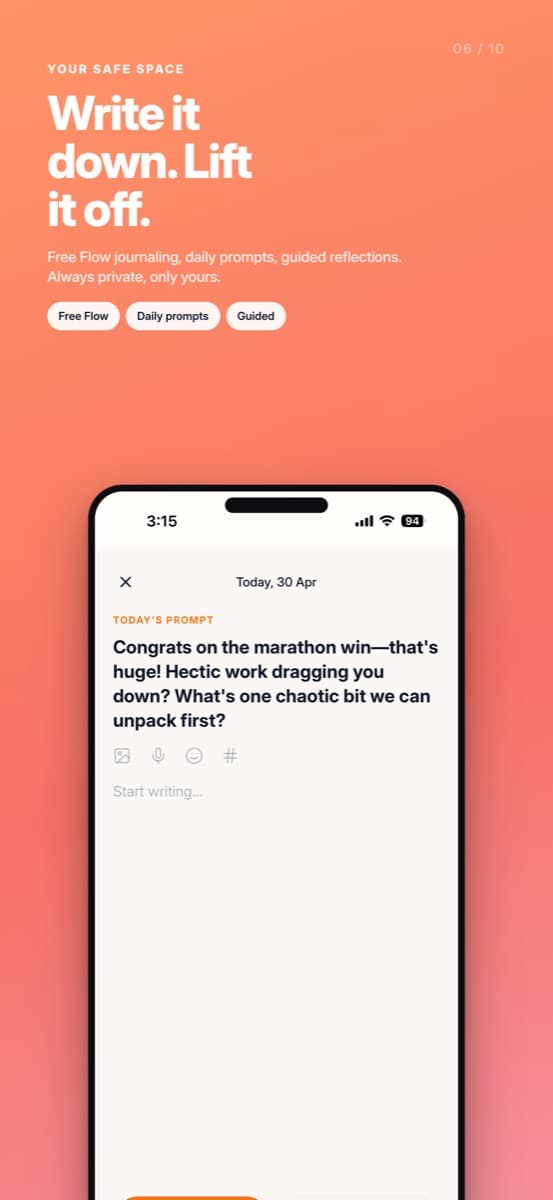
26 guided journals across six categories — gratitude, mood, sleep, CBT, productivity frameworks. Free, private, and structured enough that you actually keep going.
Browse all journals
Grouped by category — Mindtalk's signature journals first, then broader mental-health and therapeutic formats, daily reflection practices, productivity frameworks, and named methods like WOOP and GLAD.
Mindtalk Journals
6 journalsMindtalk's signature journals — proprietary content. Highest brand differentiation.
Anger Release Journaling
FreeFlow
Pregnancy Journal
Self-Compassion Journaling
Stress Resilience Journal
The Procrastination Un-blocker
Mental Health & Well-being
1 journalGratitude + Small Wins (Momentum Builder)
Emotional & Therapeutic Processing
5 journalsCBT-style and clinical processing journals. High SEO relevance — 'CBT thought record', 'anxiety loop breaker' have search demand.
Anxiety Loop Breaker (CBT Style)
Catch It, Check It, Change It
Sleep Hygiene Practice Journaling
Urge Surfing (Relapse Prevention)
Daily Reflection & Mindfulness
5 journalsEvening Reset (Daily Reflection)
The Worry Dump & Release
Goals & Productivity
2 journalsSmallest category — likely room for expansion.
Decision Journaling
Eisenhower Matrix Reflection
Specialized & Guided
7 journalsFrameworks with established names (WOOP, GLAD, Eisenhower, 1-3-5, 3-2-1, Rose-Thorn-Bud). Each has search demand under their framework name.
CBT Thought Record
Rose, Thorn, Bud Reflection
The 1-1-1 Daily Reset
The 1-3-5 Planning Rule
The 3-2-1 Reflection
Journaling is one of the few mental health practices that has good evidence, costs nothing, and asks nothing more than ten minutes and a prompt. The evidence base — expressive writing, gratitude journalling, the CBT thought record done as a daily practice rather than a one-off — points to small but real effects on mood, stress, and how readily you can talk about what is going on.
Mindtalk's library has 26 guided journals, organised into six categories so the page is not a wall of options:
- Mindtalk Signature journals — six proprietary formats covering common patterns (anger release, anxiety loop breaker, post-therapy reflection).
- Mental Health & Well-being — broad daily check-ins.
- Emotional & Therapeutic Processing — CBT-style and clinical processing journals. High overlap with CBT.
- Daily Reflection & Mindfulness — practices for end-of-day, morning, or transition moments.
- Goals & Productivity — for habit, work, or career-focused journalling.
- Specialised & Guided — named frameworks like WOOP, GLAD, Eisenhower, Rose-Thorn-Bud. Each carries its own evidence and own use case.
How journaling fits with the rest of Mindtalk
Journaling is the freeform cousin of worksheets (structured practices) and assessments (numeric scales). Most people who get the most value use all three:
- An assessment every few weeks to see how things are trending
- A worksheet when a specific situation needs a structured response
- A journal as the daily-or-weekly reflection that catches everything else
If you are working with a Mindtalk clinician, journal entries are a particularly useful thing to bring into sessions — they often surface patterns neither of you would catch in conversation alone.
How to start a journaling practice that lasts
Three things help more than anything else:
- Start short — 5 to 10 minutes is enough; 20-minute entries often turn into 3-day streaks that collapse.
- Anchor it to a fixed cue — first coffee of the day, the moment you close your laptop. Time of day matters less than the anchor.
- Use a prompt — blank pages are why most journals end at week three. Every journal in the Mindtalk library opens with a prompt, so you start writing instead of staring.
For ongoing low mood or anxiety where journaling alone is not enough, our pages on depression and anxiety explain when professional support is the right next step.
2.3M+ in-app moments of support · used by people across Bengaluru, Delhi, Mumbai, Pune, Hyderabad, Chennai & Ahmedabad and beyond.
Frequently Asked Questions
- Does journaling actually help with mental health?
- Yes — multiple controlled studies show expressive writing reduces symptoms of anxiety, depression, and stress when practised consistently. The effect is strongest when journaling uses a structured prompt (rather than open free-writing) and when entries focus on processing emotions, not rumination. Mindtalk's 26 journaling formats are designed around evidence-based frameworks for this reason.
- Which journaling format should I try first?
- It depends on your goal. For daily mood tracking and habit-building, try the Five-Minute Journal (morning or evening version). For processing anxiety, the Anxiety Loop Breaker uses CBT structure. For decluttering an overwhelmed mind, Brain Dump is unstructured and quick. For pure creative flow without a goal, Morning Pages (Julia Cameron's three-page free-write) is the classic starting point.
- How often should I journal?
- Daily journaling produces the strongest effects in research, but consistency over months matters more than frequency. Three structured entries per week sustained for 8+ weeks outperforms 7-day-a-week journaling that lasts 2 weeks. Mindtalk's app tracks your streaks and patterns so you can find your own sustainable rhythm.
- Are my journal entries private?
- Yes. Your journal entries are visible only to you in your Mindtalk account. You can optionally share entries with a Mindtalk therapist during a session if you choose — that decision is always yours and entries are never shared without your explicit action.
- Can journaling replace therapy?
- No — journaling complements therapy but does not replace it. For mild concerns or for building self-awareness, structured journaling can be effective on its own. For moderate to severe concerns, journaling works alongside specialist sessions — many therapists ask clients to journal between sessions to deepen the work.