Mental Health Journeys
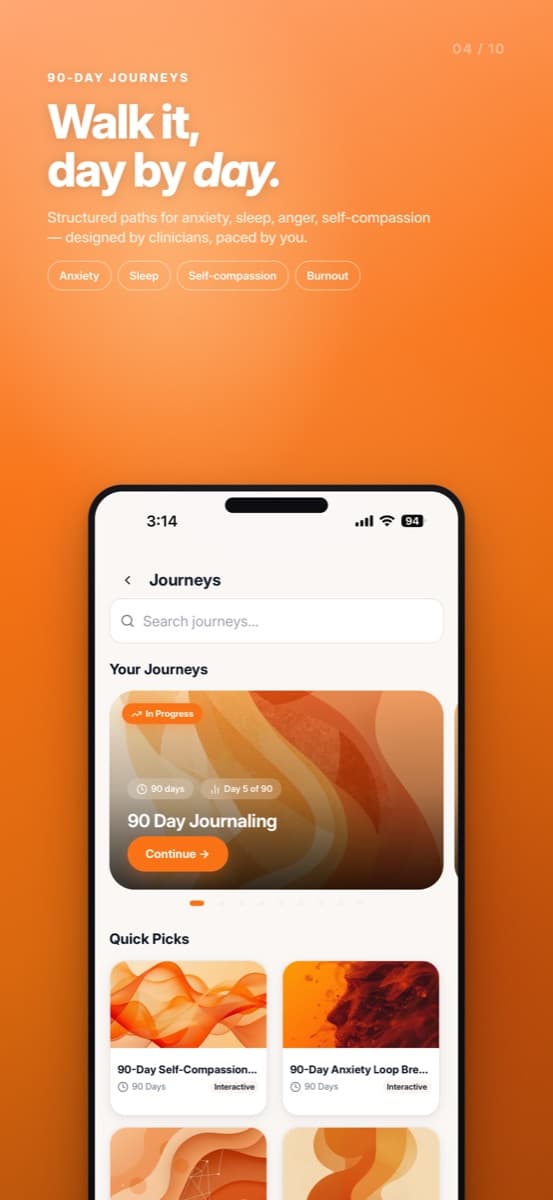
Structured 30 to 90-day programmes that turn "I want to feel better" into a clear daily path. Designed by clinicians, lived in the Mindtalk app.
5 structured 90-day programmes with your own psychologist
12 one-on-one sessions, daily clinician-designed practice, validated assessment tracking, and Dr. Riya AI in-between — all included, one fee. Distinct from the free in-app journeys below.
90-Day Stress and Anxiety Relief
CBT-based anxiety recovery — GAD-7 tracked at weeks 2, 6, 12
90-Day Emotional Reset
General mental fitness — mindfulness, weekly reflection, emotional regulation
90-Day Relationship and Family
Attachment, communication, repair — solo or in parallel with your partner
90-Day Workplace Wellbeing
Burnout recovery + prevention — MBI tracked at weeks 2, 6, 12
90-Day Pregnancy Wellness
Perinatal mental wellness — 13 sessions, EPDS-10 / GAD-7 / Wijma DEQ-A tracked
All programmes: 90 days · one assigned psychologist · daily practice · assessment tracking · one-time fee, everything included.
All free in-app journeys
Each programme is a multi-week sequence of daily practices, assessments, and reflections — bundled around a single outcome. Start with whichever fits where you are now.
90-Day Mindful Pregnancy Journey: The First Trimester
90-day programme
Pregnancy + perinatal mental health (first trimester)
90-Day Procrastination Un-blocker Journey
90-day programme
Procrastination + executive function
90-Day Gratitude & Small Wins Journey
90-day programme
Positive psychology — gratitude + small wins
Stress Resilience Toolkit
30-day programme
Stress resilience — day-by-day toolkit
A journey is what happens when "I want to feel better" turns into something you can actually do this week. Instead of a library of tools to choose from, a Mindtalk journey gives you a sequence — what to do today, what to do tomorrow, how to know it is working — designed by a clinician around one clear outcome.
Mindtalk's 18 journeys cover the most common reasons people come to mental health support: emotional reset after a difficult period, an anxiety-relief programme, building a journaling or sleep habit, and structured paths for specific contexts. Each is multi-week (most run 30, 45, 60, or 90 days), each takes a small daily commitment, and each pulls together the assessments, worksheets, and audio practices you would otherwise pick out one at a time.
When a journey is the right fit
Journeys suit people who want a clear plan more than they want a buffet. The library page lists every available journey with the focus, the duration, and what a typical day looks like — if any of them describe what you are working on, the structure makes consistency easier.
Some specific cases where journeys work especially well:
- Between therapy sessions — a 30-day journey adds shape to the week without competing with your therapist's plan
- Returning to mental health support after a gap — the structure removes the "where do I even start" friction
- You know your goal but not the path — if you can say "I want to sleep better" or "I want to feel calmer", a journey is built for exactly that
Journeys, assessments, worksheets — how they fit together
A journey is the integrating layer that uses everything else:
- An assessment at the start, middle, and end of a journey gives you a numeric read on what changed
- The journey assigns specific worksheets on specific days so you are not deciding what to do — just doing it
- Journaling prompts woven through the journey capture reflections that do not fit into a structured exercise
For specific clinical conditions, the journey is a useful complement to focused treatment. Our pages on anxiety and depression explain when a journey is enough on its own and when professional care is the better route.
Starting a journey
Pick the journey from the library that most closely matches what you are working on. If you are not sure, the 90 Day Emotional Reset is a strong general starting point — broad enough to cover most general-distress cases, structured enough to feel like progress. The journey itself begins as soon as you start it; there is no pre-work, no waitlist.
If you have not signed up to the Mindtalk app yet, the "Browse journeys" button below takes you to the catalogue.
2.3M+ in-app moments of support · used by people across Bengaluru, Delhi, Mumbai, Pune, Hyderabad, Chennai & Ahmedabad and beyond.
Frequently Asked Questions
- What is a Mindtalk Journey?
- A Mindtalk Journey is a structured 30, 45, 60, or 90-day online mental health programme. Each day includes a short clinician-designed activity — an assessment, a journal prompt, a worksheet, a guided meditation, or a reflection question — that builds on the previous day. Journeys are self-paced inside the Mindtalk app, with optional check-ins from Dr. Riya (our AI guide) and the option to add real specialist sessions whenever you want.
- How long does a journey take?
- Most days take 10-20 minutes. Total journey time ranges from 30 days (e.g. Social Media De-Addiction) to 90 days (e.g. Workplace Wellbeing, Anxiety Loop Breaker, Depression-Anxiety-Stress Rehabilitation). You set your own pace — most users complete a 90-day journey in 3-4 months at a comfortable rhythm.
- Is a Mindtalk Journey a replacement for therapy?
- No — a journey is a structured self-help programme designed by Mindtalk's clinical team. For mild to moderate concerns, journeys can be highly effective on their own. For severe, persistent, or crisis-level concerns, a journey works best alongside sessions with a Mindtalk specialist. The journey itself often helps you understand whether you need additional clinical support.
- Can I do more than one journey at the same time?
- Most users get the best results by focusing on one journey at a time. Different journeys often overlap thematically (e.g. burnout journey + sleep audit), so completing one before starting another helps consolidate the skills. Exception: pairing a 90-day clinical journey with the 12-week Emotional Reset Journey works well — they're complementary.
- What happens after I complete a journey?
- You receive a completion summary showing your progress across assessments, journal entries, and milestone reflections. The app then suggests follow-up options — a related journey, a maintenance worksheet plan, or booking a specialist session to consolidate what you learned. Many users repeat foundational journeys (like Emotional Reset) annually as a mental health check-in.